The end of the nest comes suddenly, like a death, but not by surprise.
Of course, it still takes me by surprise.
Though that makes no sense.
The grief doesn’t make sense either.
Did I want a perpetual child?
Did I want my son to live with me forever?
It is so right that he is going.
And completely wrong…
The only other time I’ve felt so at odds was at birth, when I longed to be free of the weight in my belly, and yet felt so complete with a baby inside.
The first time I ever yelled at my son was at our back door on our way out to preschool. I was pregnant, feeling awful, and my steady supply of patience had suddenly evaporated. It was downhill after that. My bubble as a “perfect parent” popped, again and again, particularly once I became a mother of two boys.
That said, I had a strong skill set for parenting. I had been the oldest of eight and an elementary school teacher by profession. In fact, I had been my son’s preschool teacher for 2 years until he fired me: “Mom, would you leave like the other Mom’s do?”
When I left the preschool the following year, I was given the job of coordinating an ongoing parenting workshop in our district. I was an eager participant as well. I explained that I held so much personal power in the home that I wanted to be sure my boys came into their own. The majority of the others complained that their children never listened to them.
“All I do is yell,” confided one mother.
I’ll never forget that admission because her sadness touched me, and I also wondered about it. Why did she yell? Didn’t she bring her boys up to listen to her? It takes persistence, but it can be done; and it’s much more effective and empowering than yelling.
It would be ten years before I realized that I had become that mother. It didn’t happen over night. It crept up on me, like a slow, growing fungus. Frustration played a part, fatigue did too, as did the diminishing return of being a perfect parent.
My oldest was 10 when the fungus picked up its pace. It was time for violin practice, and he not only balked, but refused. When I insisted, with accentuated volume, he had the audacity to leave. He ran out the door and hid behind his rock pile. My husband encouraged me not to follow him.
But when he returned, there were fireworks. I’ll never forget coming face to face with my own powerlessness as we yelled at each other at the top of the stairs; or the desperate absurdity of my next move: “I’m going break all your toys,”I said.
There was a long pause while we absorbed my threat, followed the expansion of our mouths into a smile, and then laughter.
It was time for my role as Commander in Chief to change; and to tell the truth, looking back now, seven years later, as my son rounds out the last semester of high school, I did a pretty good job with the transition. We still like each other; and even though the fireworks have increased over time, they are more frequently followed by understanding and acceptance and even… affection.
Lately, this emerging adult confides that my personal power is intimidating. That even though I listen and consider and even change my mind at times, I have such a commanding manner, that even when I’m giving, I can be taking away.
I resent this. I want everyone to find their own power. I don’t want to diminish mine just to make them comfortable. I’ve worked hard to claim this power in my life; it’s what enabled me to transcend a great deal of pain and to create the beautiful fulfilling life I have now –which includes a positive relationship with my teenager.
It seems a shame to be giving up my voice just when I’m coming into it as a middle-aged woman with dramatic hormonal surges of clarity, but I listen and consider and begin to shape a plan; because that’s how much I love these men–not only my husband and my teenager–but his younger brother, who at 12 is still a sensitive soul who can’t bear these heated arguments.
I know that the last handful of years has taken its toll on my youngest; and that by the time his brother is off to college, he’ll begin his own adolescence. Perhaps this second act will be less intense, simply because it’s no longer a complete unknown. Maybe it will feel as easy as it did when he was born and we had already endured the initiation into parenting so that we spent much of the time coasting. Maybe we’ll be more relax more this time around with a teenager, knowing that we didn’t totally fuck up the first one.
But you never know. Things can be going on swimmingly, and then a tidal wave comes out of nowhere. Like the day before last. When my oldest and I went head to head at breakfast and I banged my fist on the table like I’d seen my father do. My younger son resigned himself to leaving the room, while my husband rebuked us, again and again.
Growing up in what could be a volatile home, my husband was afraid of anger, and rarely expressed it. He was also the middle child, the peace maker, and so his first-born wife was infuriated each time he stood the middle ground instead of rolling up his sleeves to tackle the intensity of parenting a teenager. “I’m raising a man!” I’d rant with all my mid-life fury, challenging him to tell me what he was after.
This is how the intensity built on Sunday so that what started out as a typical disagreement between two parents and their son mutated into ongoing fireworks between husband and wife; only I was the only one launching anything of color. By the time my husband truly engaged, at the tail end of a tiring day, he was fully loaded–with pain. The pain from a lifetime of witnessing volatility, the pain of fear and powerlessness, and the frustration of facing my angst and anger without expressing his own or without being able to communicate how toxic the build up was for him.
The result was–chilling and sobering and a wakeup call–for both of us. His–to more fully explore the pain he never felt or flushed; Mine–to realize the impact that my own volatility might have on my family.
I decide to go on a diet. A volume diet. A power diet. I will not relinquish my hard-earned voice, but I will cultivate it on the inside so that my sons and my husband might have more space to cultivate their own.
I check the calendar and discover that “lent” begins tomorrow. What a coincidence! (I’m not even Catholic.)
Those years of spanking, with the belt, on my naked bottom, over his lap–those were a legitimate act of parental discipline, right? And the time when I was a grown woman, home from college… and he hit me across the face with the back of his hand; not once, but three times; that wasn’t the kind of wrong where you press charges because I had mocked the authority of the man who provided for me, right?
When does standing up for yourself shift from disobedience to claiming ones rightful place in the world? And what earns that place?
Money or size?
And what about respect? How is that come by? Does it only flow in one direction? Who decides?
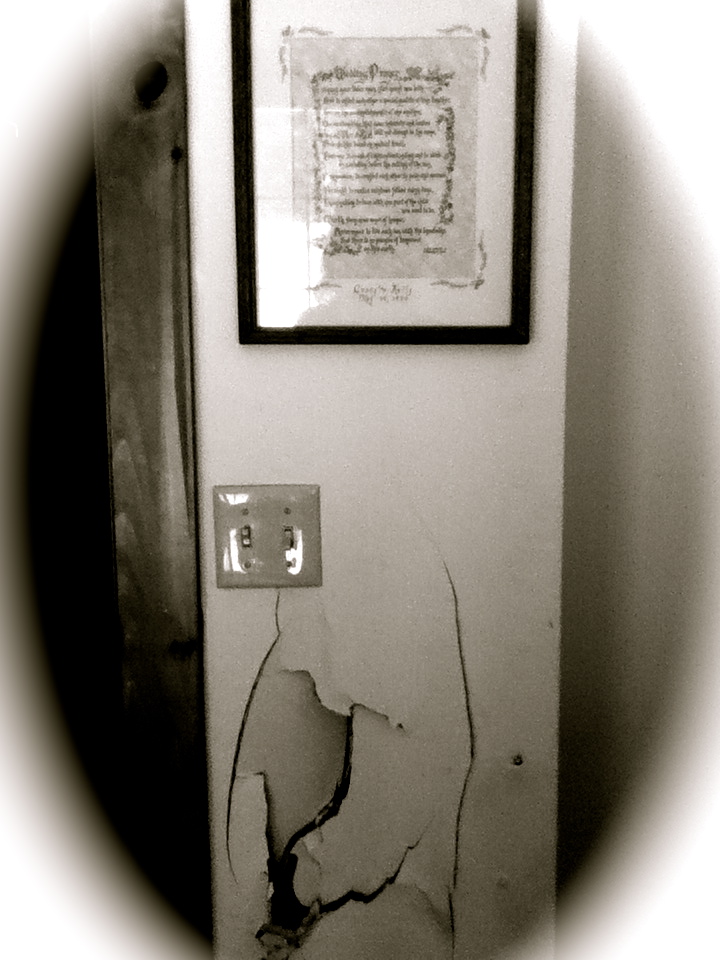
These are the questions I’ve asked myself as a woman, but up until now I’ve never realized that I was among those violated. Until my husband punched our door in the middle of a heated argument, and then kicked the wall beside the bed until the sheet rock collapsed on itself; then, I realized; this is about “them,” this is about all women.
My first thought was the children. My teenager remained safely behind his closed door while my 12 year old called out from his dreams. I rushed to his room and sat beside him until he settled back into a softer sleep.
Then I quickly returned to the bedroom, grabbed my things, and headed downstairs. I considered leaving, as I had in college when my father gave me the black eye, but where would I go and why would I go?
I made up a bed on the couch and put the phone beside me. The room was dark except for the glow of the wood stove so I could barely see my husband arrive at the bottom of the stairs.
“Don’t come any closer,” I said. “I’ll call the police. I mean it.”
He said my name desperately, unbelievably, before resigning himself to leave. I ached for his grief but I felt afraid of him at the same time. His outburst had triggered a lifetime of vulnerability and intimidation.
I wondered if I was to blame like I had been as a child… when I was bad; or as a young adult when I was disrespectful. I was reminded of what my in-laws once “joked” in a heated moment when they felt their son was victimized by my constant demands: “Maybe he takes you out back and beats the crap out of you.”
I tried to fall asleep, but I kept thinking about the wall, and about how that could have been me, and about how some woman somewhere was definitely being kicked across a floor while her children screamed. I was definitely not returning to that room until the wall was repaired.
When the floor creaked above me, I froze. When another tall figure appeared by the wood stove, I sprung upright, and reached for the phone, ready to dial.
It was my oldest son. He lay down beside me in a space that was smaller than a single bed even though our queen had been too close for his comfort for years on end. He wrapped his arm around me and took my hand in his.
“I’m sorry,” I said.
He stayed for an hour. We talked. About ourselves. About anger. About self-expression. About power. About helplessness. When I heard the floor creak again, I moved my hands through the blankets, but I couldn’t find the phone. My son asked what I was doing, and at first I said, “Nothing,” but then I attempted to explain the vulnerability that is unique to women.
He listened attentively and then apologized for not coming to me when he first heard his father’s outburst.
After he left, I lay there, softening, wishing for my mother, wanting the comfort of my husband. I suddenly understood how a violated woman might return to the lover who had abused her.
I remembered that my father once confided to me that he’d hit my mother “only a few times” when she was overly emotional. I was appalled; and couldn’t understand why she hadn’t stood up for herself or for me when he hit me. But we were both petite women, and he was towering. That and the fact that my mother was born only twenty years after women claimed the right to vote; and I would be ten before “marital rape” was a crime in every state. That kind of subjugation lives on covertly in the dynamic of the culture for generations.
My own husband is a kind, gentle man, not prone to anger, but he grew up in what could be a volatile home, as did his parents before him. Those legacies don’t just disappear. Not without attention. And consciousness. And courage.
I began to realize that the threat I felt was not so much about the man upstairs as it was about the position of women throughout time. My mind turned to all those who are terrorized the men in their lives–by lovers, fathers, brothers, husbands–in the past and in the present–and especially those among us who are too threatened to get help.
I woke the next morning, in my own bed, with a pounding skull, and a tight jaw, and a stiff neck. “This is trauma,” I thought. (And I hadn’t even been touched.)
I decided that our wall wouldn’t be repaired right away after all. That we would use it as a reminder of what is at stake. Particularly today as our lawmakers deliberate over VAWA: The Violence Against Women Act.
I am certain that whatever rights and protections are bestowed upon women are bestowed upon us all; just as whatever trauma is inflicted impacts us all.

 Of course, it still takes me by surprise.
 The Empty Nest Diary